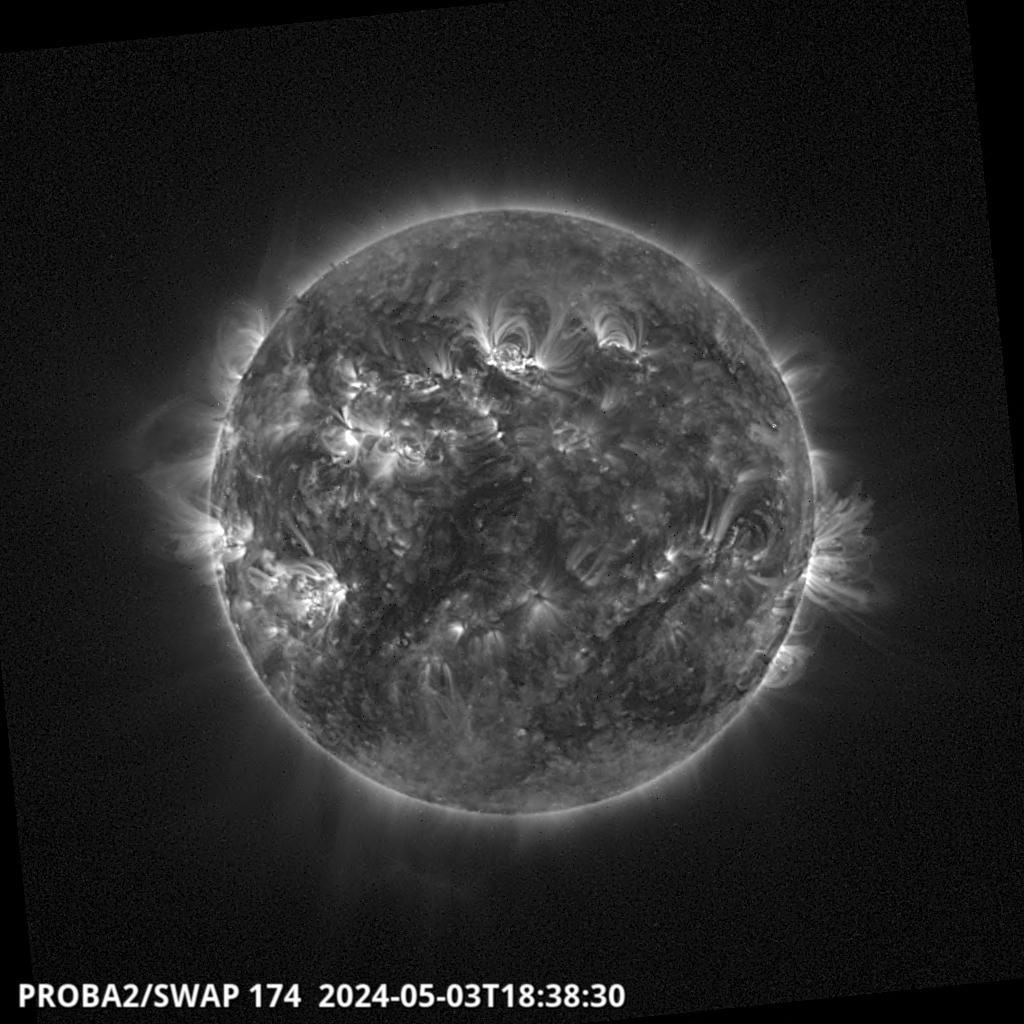
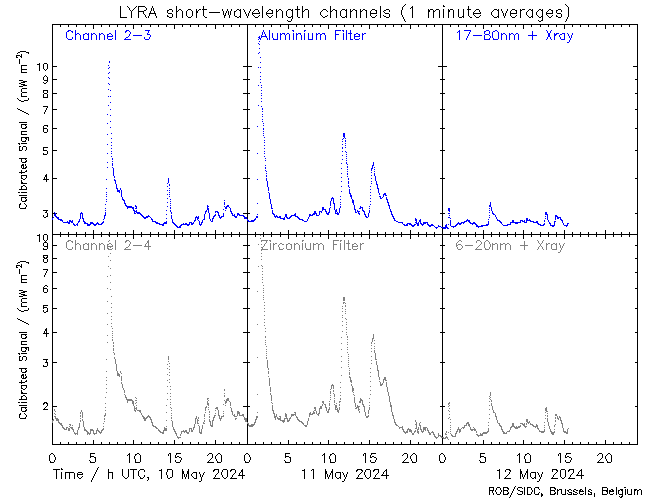
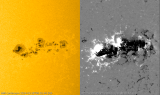
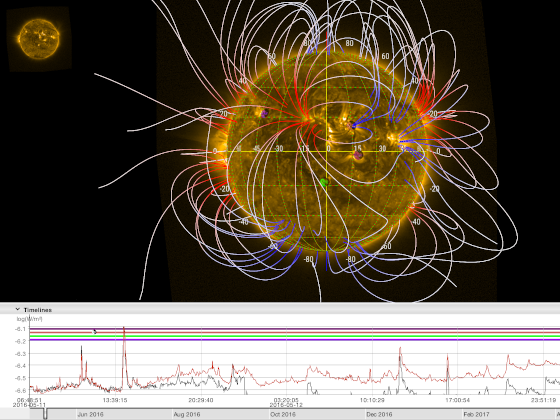
Solar flaring activity was at moderate level, with multiple C-class flares and one M-class flare recorded in the past 24 hours. The largest flare of the period was an M1.1 flare, peaking at 18:02 UTC on Apr 16, associated with NOAA AR 3645. NOAA AR 3639, that has grown in size and became magnetically more complex (from beta-gamma to beta-gamma-delta) was the main driver of the flaring activity observed over the past 24 hours together with NOAA AR 3637 (beta-delta), NOAA AR 3641 (beta) and NOAA AR 3643 (beta-gamma). Other regions on the disc have simple configuration of their photospheric magnetic field (alpha and beta) and did not show any significant flaring activity. The solar flaring activity is expected to be at moderate levels over the next 24 hours, with M-class flares possible and a chance for X- class flare.
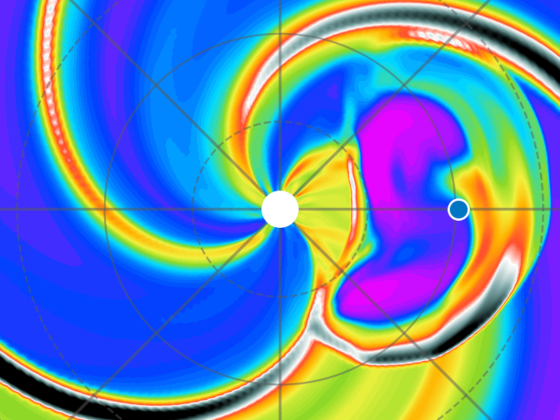
A small filament eruption occurred in the southeastern quadrant from around 18:36 UTC on Apr 16. The associated coronal mass ejection (CME) was observed in SoHO/LASCO C2 coronagraph data from 20:36 UTC onwards. The CME is directed primarily to the South from the Earth's perspective, analysis is ongoing to determine if there is an Earth-directed component.
Another filament eruption was observed in the northern quadrant, first seen in SDO/AIA 304 at around 01:16 UTC on Apr 17. An associated faint CME can be seen in SOHO/LASCO-C2, however we are awaiting corresponding coronagraph data for further analysis. No other Earth-directed CMEs have been detected in the available coronagraph imagery over the past 24 hours.
Small negative polarity equatorial coronal hole has began to cross the central meridian today, on April 17.
The greater than 10 MeV proton flux was at nominal levels over the past 24 hours and is expected to remain so for the next 24
hours.
The greater than 2 MeV electron flux, as measured by the GOES-16 satellite, remained below the 1000 pfu threshold. It is
expected to remain below the threshold during the next 24 hours. The 24 hour electron fluence was at normal levels and is expected to remain at these levels for the following 24 hours.